01 / MEET THE DATA CENTER UPS
A protected bridge between power and IT
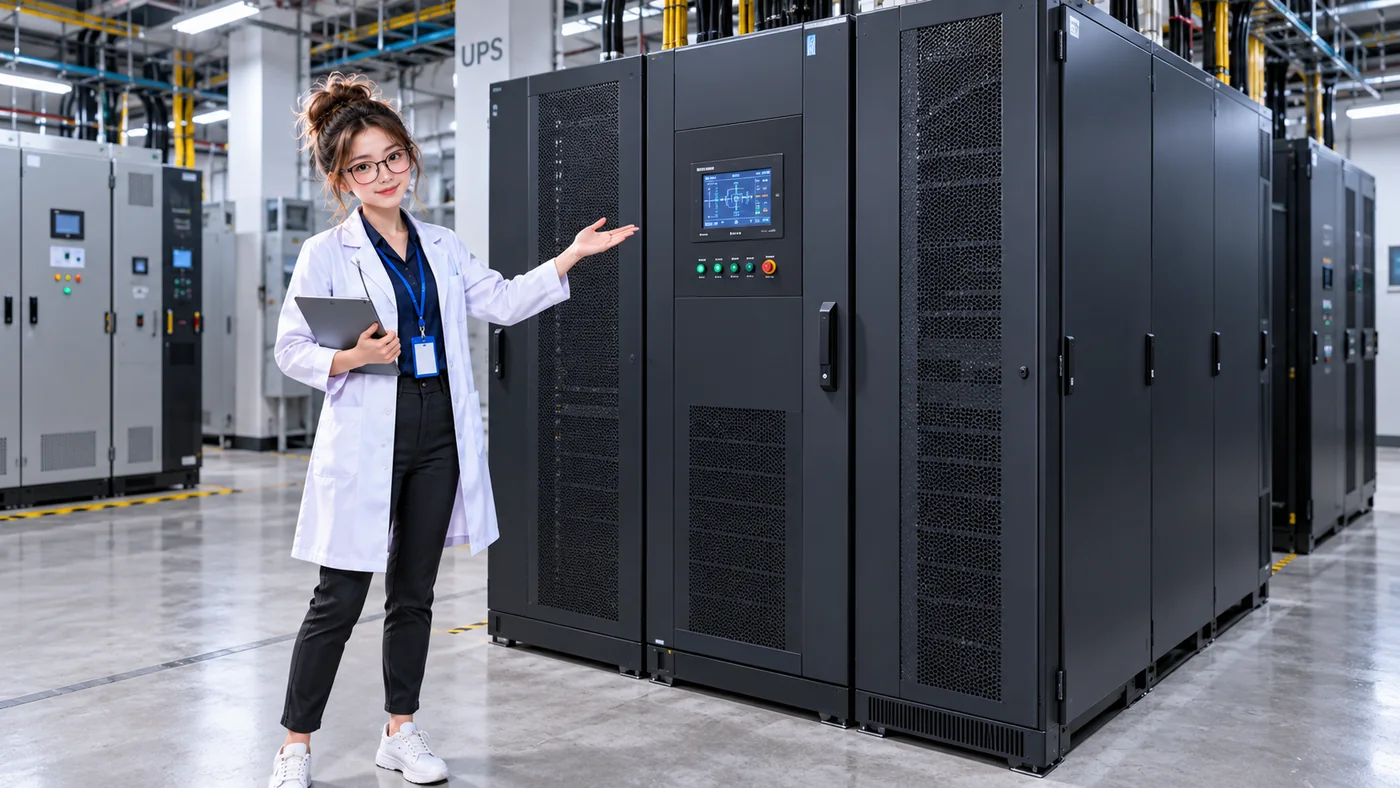
A data center UPS is facility electrical infrastructure that helps maintain a stable, continuous supply to protected equipment. It may be a large modular or centralized installation supporting substantial IT loads—not simply the small UPS found under a desktop computer.
Servers rely on electricity to keep computing. If normal input power is lost, an appropriately designed UPS can support its protected output while the facility responds. In a simplified power path, the UPS sits upstream of the PDU, which distributes power to equipment such as the server.
- Utility / grid
- UPS
- PDU
- Server
02 / WHAT DOES IT DO?
Three jobs a UPS can perform
Power continuity
When normal input disappears, stored energy and power electronics can keep the protected output supplied without waiting for a generator to start.
Power quality
Depending on the UPS topology and design, conversion and control can help isolate the load from certain power-quality disturbances. Protection varies by system.
Bridge time
The UPS provides a transition while another source becomes available or the normal supply is restored. Its available runtime is finite and depends on the system.
A SIMPLE POWER STORY
What changes when utility power is interrupted?
Normal operation
- Utility available
- UPS conditions and supplies output
- PDU
- Server
Power interruption
- Utility unavailable
- UPS energy storage supports output
- PDU
- Server remains supplied during available bridge time
This simplified view shows the continuity role. The UPS does not provide unlimited energy; the supported duration depends on load, storage, and operating conditions.
03 / MORE THAN A BATTERY
A UPS is a complete power system
A UPS typically combines power-electronic conversion and control equipment with an energy-storage system. The storage matters, but it is one part of the larger system that manages incoming power and supplies a protected output.
- Incoming electrical power
- UPS power electronics & control
- Protected output
Energy storage supports the system when needed
04 / WHERE DOES THE ENERGY COME FROM?
Stored energy supports the load
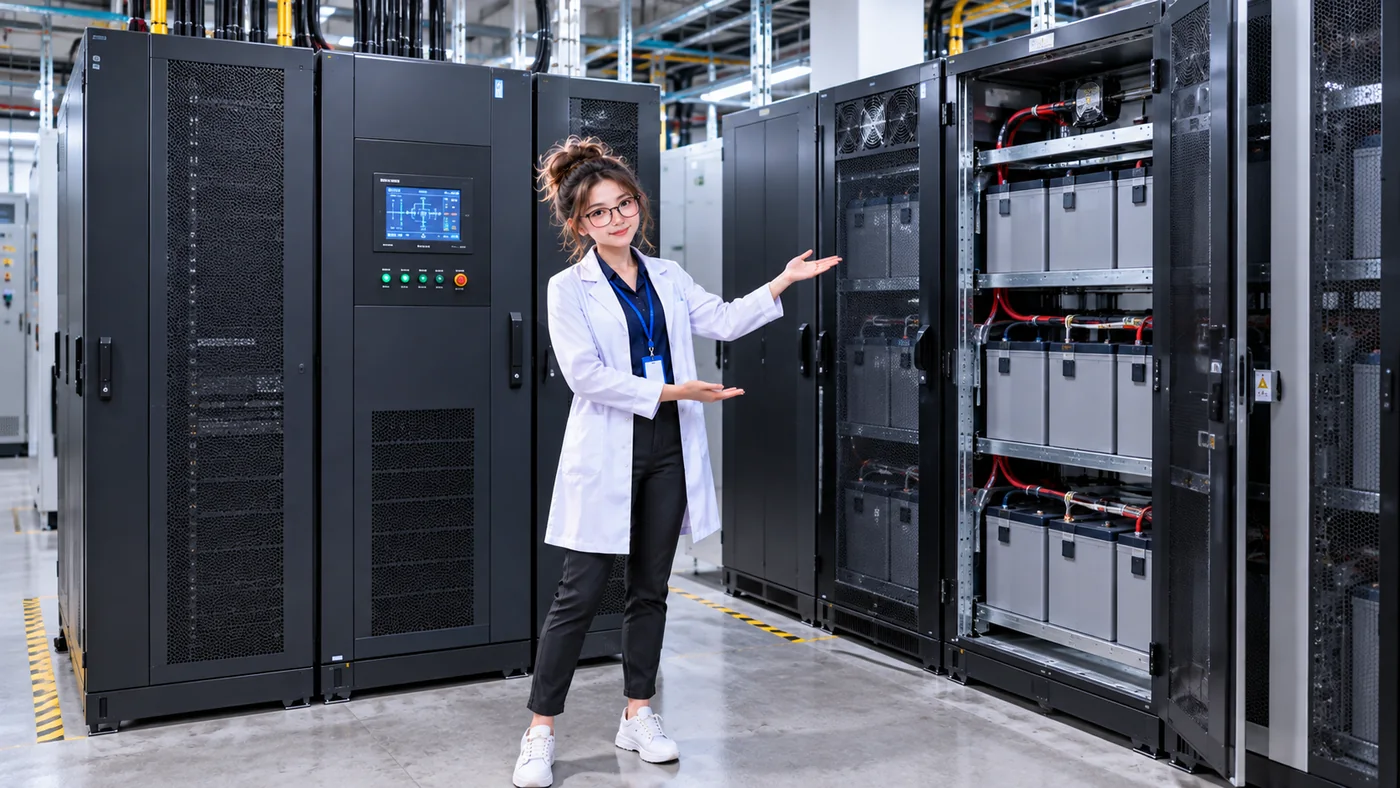
When normal input power is interrupted, the UPS energy-storage system can provide energy to support its protected output. Battery cabinets may contain strings or modules that work together. Monitoring can track conditions such as state of charge and help estimate available runtime.
Battery layouts, technologies, and other storage designs vary. The equipment shown here is one visual example, not a configuration used by every data center.
05 / HOW LONG CAN IT RUN?
Runtime depends on the load and the storage
There is no single runtime that applies to every UPS. Available support depends on the protected load, storage capacity and condition, UPS design, storage configuration, and operating conditions.
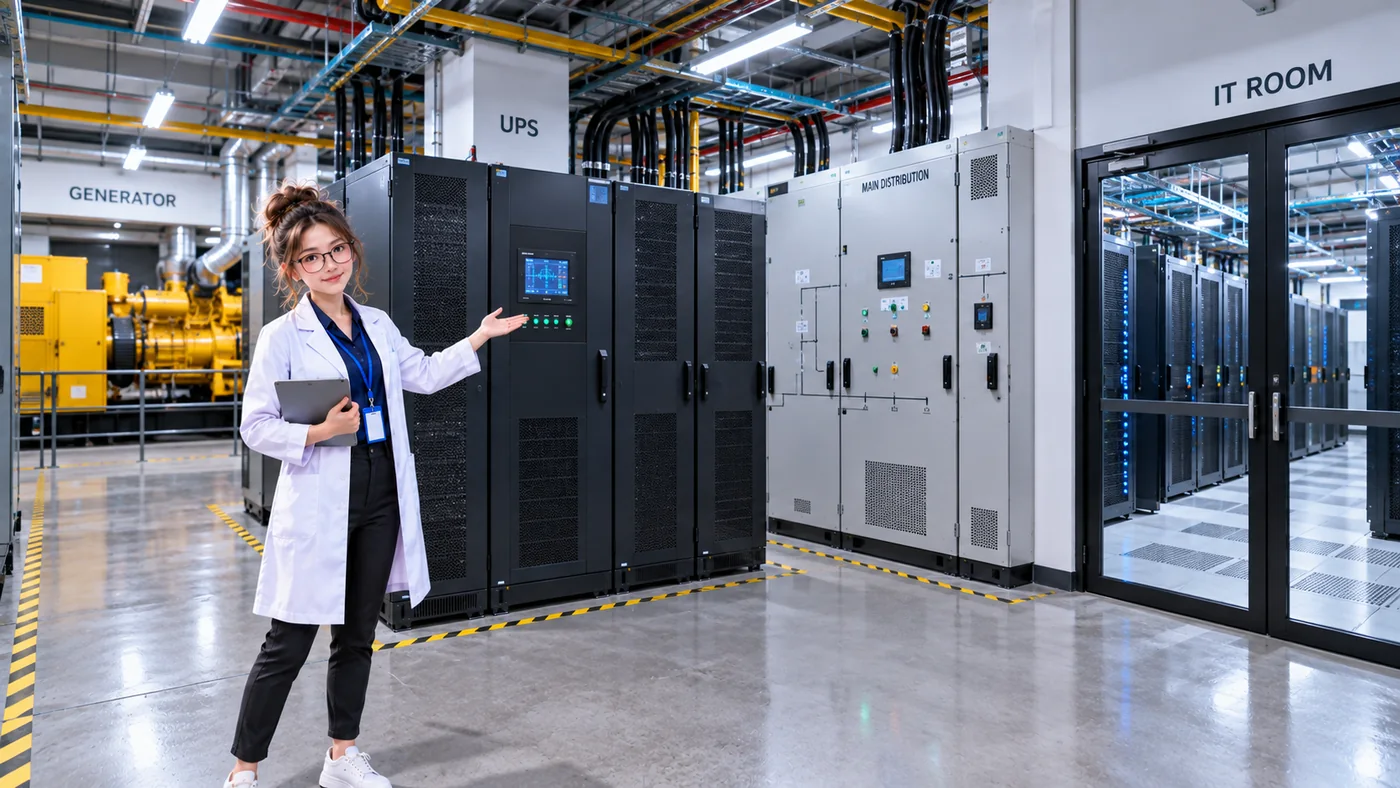
In many data center designs, the UPS is not intended to be the long-duration primary source through an extended outage. Stored energy can provide the critical bridge while standby generation starts and becomes available. Facility architectures differ, so the planned transition and autonomy need to match the actual design.
TWO SYSTEMS, DIFFERENT ROLES
UPS vs. generator: how they work together
UPS
- Provides near-immediate continuity to protected loads.
- Uses stored energy during an interruption.
- Bridges short disturbances and transition periods.
- Power conversion and conditioning depend on topology.
Standby generator
- Produces electrical power from a fuel or other energy source.
- Needs time to start and become ready for connection.
- Can support longer outages when properly designed and supplied.
- Works with the facility’s transfer and control arrangements.
They are often designed to work together: the UPS bridges the transition, while a generator can supply power for longer outages. Continue the component journey with theContinue with the Backup Generator beginner lesson.
06 / WHAT HAPPENS WHEN THE GRID FAILS?
A simplified failover sequence
During a data center power failure, think of the UPS as the part that supports protected loads during the transition, while the facility brings another source online. The exact switching and control sequence depends on the electrical architecture.
- Utility healthyNormal input supplies the system.
- Utility failsThe normal source is interrupted.
- UPS holds loadStored energy supports protected output.
- Generator startsAfter a start command, standby generation reaches operating conditions.
- Generator becomes availableTransfer controls connect an appropriate source.
- Protected load continuesThe UPS keeps conditioning or supporting output as designed.
This is an illustrative sequence, not a universal switching procedure. Real facilities use different transfer sequences, redundancy arrangements, and controls; actual timing depends on the system.
Once an appropriate generator-backed source is connected upstream, the UPS can continue to protect the load. Its energy storage may recharge according to the system’s controls and operating conditions.
WHY NOT USE ONLY A GENERATOR?
Servers need power during the start-up transition
A standby generator is mechanical equipment. It generally needs time to start, stabilize, and become available to the electrical system. Critical servers cannot wait without power through that transition, so the UPS can bridge it while the facility’s transfer system connects the appropriate source.
A FIRST LOOK AT RESILIENCE
What if a UPS path fails?
Critical facilities may use multiple UPS modules, separate A/B paths, bypass arrangements, or capacity redundancy such as N+1. These are ways to build data center power redundancy, but redundancy labels alone do not guarantee resilience: shared upstream dependencies or insufficient capacity on the surviving path can still interrupt service.
Explore how independent paths and remaining capacity affect the result inA/B Power Redundancy andN-1 Resilience.
KEEP THESE IN MIND
Three things to remember
- A UPS helps maintain immediate continuity when normal input power is interrupted.
- Energy storage is part of a UPS system, which also includes power electronics and control.
- UPS and generator often work together: the UPS bridges a transition and generation can support a longer outage.
LEARN → UNDERSTAND → SIMULATE → STRESS-TEST
Now simulate a power failure
You have followed the physical power path. In the UPS Battery & Generator Failover lab, observe a utility interruption, UPS battery support, generator startup, and load acceptance in the model. Try changing the transfer and stored-energy settings to see whether the modeled load stays served through the transition.